

Two years ago, I opened a Robinhood account with $1,000.
The idea was simple: I wanted to see what I could do with a small account if I treated it seriously. No deposits or withdrawals. No pretending I could predict the market. Just trading stocks, options and, occasionally, futures while trying to grow the account over time.
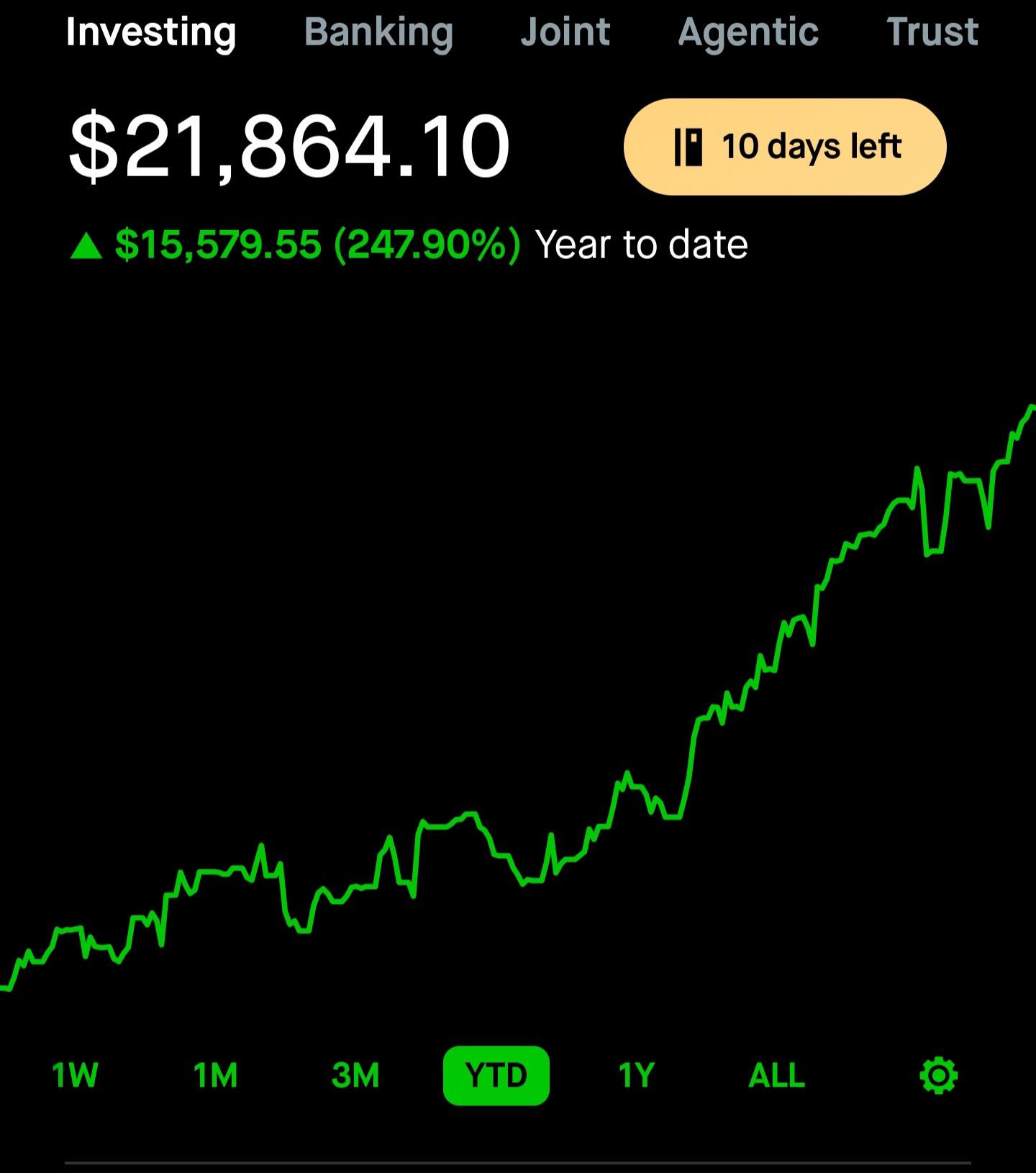
Fast-forward two years, and the account is now worth $21,864.10. The screenshot above shows a $15,579.55 gain, or 247.90%, year to date. Those are great numbers, but if you only look at the green line going up, you are missing the most important part of the story.
The real lesson isn't how much I've made. It's how much I'm willing to lose along the way. That is where risk and drawdown management come into play.
Making Money Is Only Half the Job
Anyone can have a good trade. You can buy the right stock, catch a momentum move, sell an option at the perfect time or get lucky with a short-term trade. The problem is that one great trade can create a false sense of confidence. You start increasing your position size. You take more trades. You sell more options. You stop respecting your original risk parameters. Then the market reminds you who is in charge.
I've been trading for decades, and I've learned that protecting capital is more important than maximizing any individual trade. My objective isn't to make the most money possible every single day. My objective is to stay in the game long enough for the winners to compound.
Drawdowns Are Inevitable
If you're trading stocks, options or futures, you're going to experience drawdowns. There is no strategy that produces a straight line from the bottom left to the top right. Even the account in this screenshot has experienced plenty of pullbacks along the way. The chart looks great when you zoom out, but I can assure you there were days when the account was going in the wrong direction.
That's normal. The mistake is believing that a drawdown means your strategy isn't working. A 5% drawdown is one thing. A 30% drawdown is an entirely different problem.
Here's why: If you lose 10%, you need an 11.1% gain to get back to breakeven. Lose 20%, and you need 25%. Lose 50%, and you need to make 100% just to get back where you started.
This is why risk management isn't exciting, but it is essential.
Position Size Is Your First Line of Defense
One of the easiest ways to control risk is to control how much money you put into each trade. If your entire account is riding on one YOLO position, you aren't investing. You're making a concentrated bet, you are gambling! I would much rather have several positions with defined risk than put a huge percentage of my account into one trade and hope I'm right.
This becomes particularly important with options. Options give you leverage, and leverage cuts both ways. A trade that looks attractive because you can potentially make 30% can become dangerous when you realize you can also lose 30%, 50% or even 100% of the capital committed.
Don't confuse the amount you can make with the amount you should risk.
Don't Let a Winner Turn You Into a Gambler
This may be the most difficult lesson after a big winning streak. When your account is going up, you feel smarter than you actually are. I've experienced it myself. After several successful trades, it's tempting to increase position sizes because you think you've figured something out. But the market hasn't changed. Your confidence has. That's when discipline matters most.
A winning streak should make you more disciplined, not less. Take some profits. Reduce risk when necessary. Keep cash available. And understand that the next trade doesn't care how well the previous five trades performed.
My $1,000 Experiment Has Become a Lesson in Survival
When I started this account with $1,000 two years ago, I wasn't thinking about turning it into $20,000. I was thinking about showing to new traders what was possible with a small amount of capital.
Today, with the account at $21,864.10, the biggest lesson isn't the 247.90% YTD return. It's this: You don't compound capital by avoiding losses. You compound capital by keeping your losses small enough that they don't knock you out of the game.
There will always be another trade. There will always be another opportunity. You don't have to make money on every trade, every day or every week. But you do have to manage your risk every single time you put capital to work. The goal isn't to have a perfect equity curve.
The goal is to survive the drawdowns, protect your capital and let the winners compound. That's how a $1,000 experiment can eventually become something much bigger.


